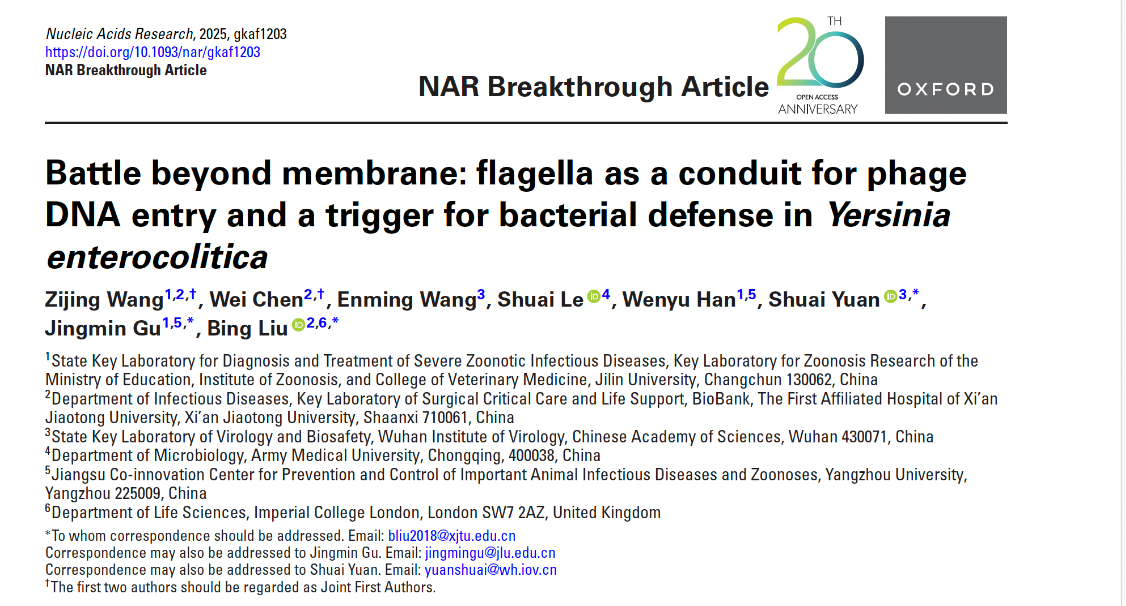
Recently, a collaborative team led by Professor Liu Bing of the First Affiliated Hospital (FAH) of Xi’an Jiaotong University (XJTU), together with Professor Gu Jingmin of Jilin University and Professor Yuan Shuai of the Wuhan Institute of Virology, Chinese Academy of Sciences, published a breakthrough article in the top international journal in the field of nucleic acids research, Nucleic Acids Research, entitled “Battle beyond membrane: flagella as a conduit for phage DNA entry and a trigger for bacterial defense in Yersinia enterocolitica”. The study, for the first time, systematically reveals the dual role of flagella during phage infection: they function not only as a conduit for phage DNA entry into host cells, but also act as a key alarm sensor that triggers bacterial defense by enabling the cells to sense viral attack and initiate immune responses. This discovery profoundly reshapes our understanding of the complexity of phage-bacterium interactions and provides an important theoretical basis for the future optimization of phage therapy and the development of novel anti-infective strategies.
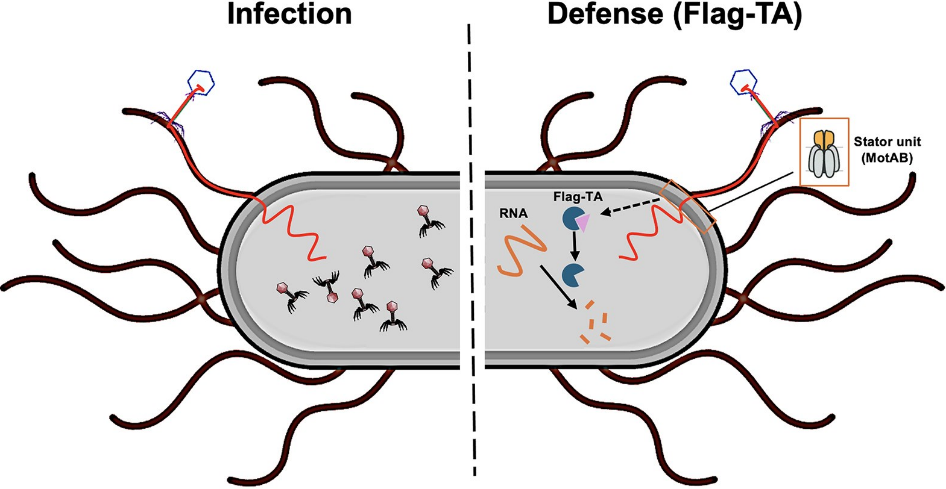
Using the food-borne pathogen Yersinia enterocolitica and its phage X1 as a model, the research team carried out a systematic study and, for the first time, identified the dual role of bacterial flagella during phage infection. They demonstrated that phage X1 employs a contraction-driven mechanism of invasion: by contracting its tail like a molecular syringe, it directly injects its genomic DNA into the inner channel of the flagellum. This mechanism is distinct from previously characterized flagellum-dependent phages and represents a completely new viral invasion strategy.
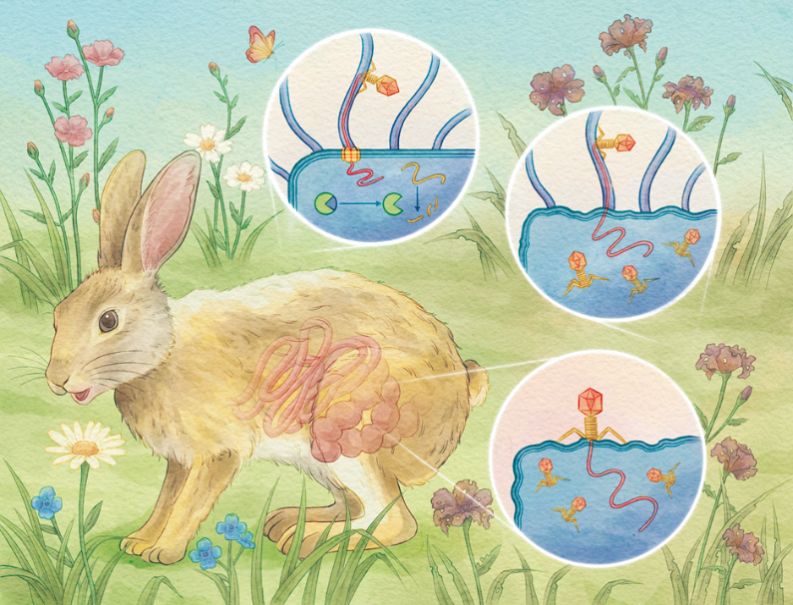
At the same time, phage X1 has evolved a “multi-entry” infection strategy: in addition to flagella, it can efficiently exploit lipopolysaccharides (LPS) on the bacterial surface as receptors for infection, with this latter route showing even higher infection efficiency and extending beyond the traditional category of strictly flagellum-dependent phages.
In the face of phage attack, certain Yersinia strains have evolved a flagellum-dependent “suicidal” defense system. Once the bacterium senses invasion by phage X1 via its flagellum, the signal is transmitted through the key flagellar motor stator proteins MotAB to activate a flagellum-dependent toxin-antitoxin (Flag-TA) system. The infected cell then initiates an abortive infection (Abi) response, sacrificing itself to block phage replication and spread and thereby protecting the bacterial population as a whole.
The first author of this paper is Wang Zijing, a doctoral candidate at Jilin University, and Chen Wei, a doctoral candidate at XJTU, is listed as a co-first author. Professor Liu Bing from the FAH, Professor Yuan Shuai from the Wuhan Institute of Virology, Chinese Academy of Sciences, and Professor Gu Jingmin from Jilin University serve as the corresponding authors.
Original article link: https://academic.oup.com/nar/article/53/21/gkaf1203/8329110?searchresult=1