Recently, Professor He Yingli’s team from the Department of Infectious Diseases at the First Affiliated Hospital (FAH) of Xi’an Jiaotong University (XJTU) published the results of a retrospective cohort study in the international journal BMC Infectious Diseases, entitled “HBsAg loss in recipients with chronic hepatitis B after allogeneic hematopoietic stem-cell transplantation: a retrospective cohort study exploring kinetic dynamics”. The study systematically elucidates the kinetic pattern of hepatitis B surface antigen (HBsAg) clearance in patients with chronic hepatitis B after allogeneic hematopoietic stem cell transplantation, providing new directions for the treatment of chronic hepatitis B in high-risk special populations.
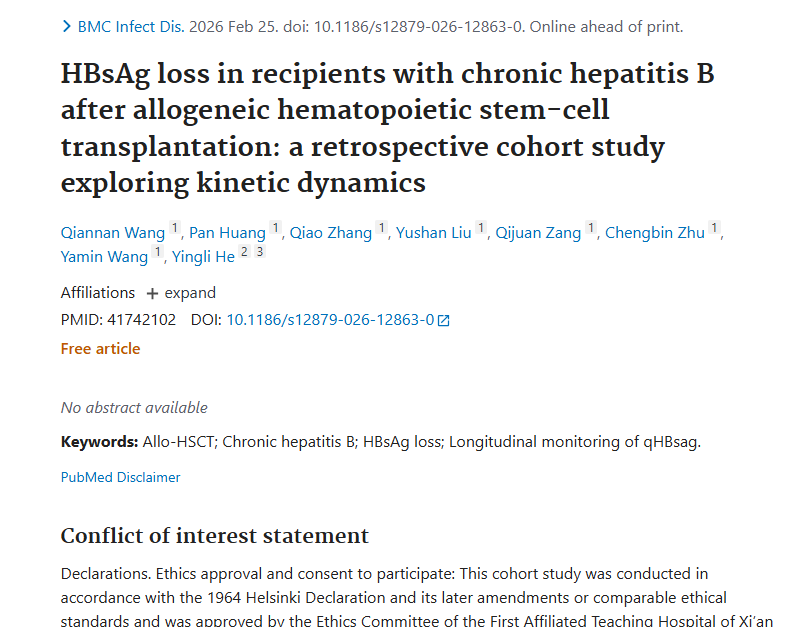
This study enrolled 15 patients with chronic hepatitis B complicated by hematologic malignancies who underwent allogeneic hematopoietic stem cell transplantation between January 2013 and December 2023. With a complete follow-up of up to 10 years, this represents a comprehensive long-term study in this field. The team conducted long-term monitoring under a standardized protocol, with intensive post-transplant tracking of key indicators, including HBsAg, hepatitis B virus markers, and quantitative HBV DNA.
The results showed that 2 out of the 15 patients (13.3%) achieved sustained HBsAg loss and seroconversion at 6 and 12 months post-transplant, respectively, meeting the criteria for functional cure of chronic hepatitis B. In these patients, HBsAg levels continued to decline steadily and persistently after transplantation. In contrast, patients without HBsAg clearance exhibited stable, slow decline or transient fluctuations, and this kinetic pattern could be used for early prediction.
This study also confirmed that, under standardized antiviral prophylaxis, transplantation was safe and effective for this patient group, with an overall survival rate of 72.52% and no deaths from HBV-related liver disease. Donor anti-HBs positivity may confer passive immunity to the recipient, assisting in hepatitis B control.
This study, with Wang Qiannan as the first author and He Yingli as the corresponding author, provides important evidence for the individualized diagnosis and treatment of patients with chronic hepatitis B undergoing stem cell transplantation.
Article link:https://pubmed.ncbi.nlm.nih.gov/41742102/