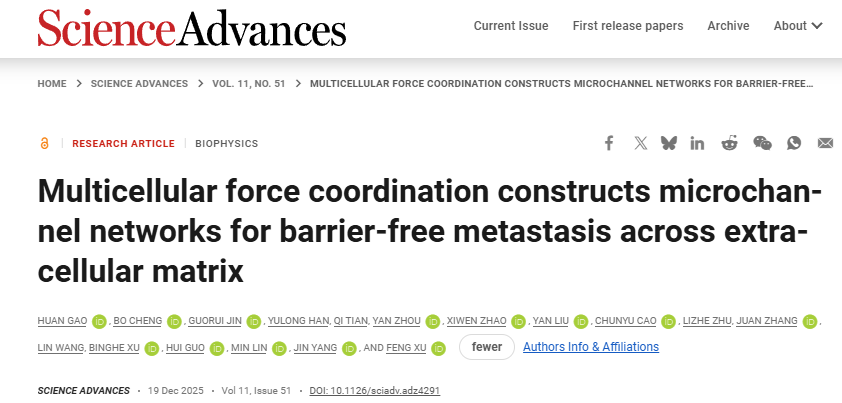
Recently, the research group led by Professor Yang Jin at the First Affiliated Hospital (FAH) of Xi’an Jiaotong University (XJTU) collaborated with the team of Xu Feng from the Bioinspired Engineering and Biomechanics Center (BEBC) of XJTU to achieve a major breakthrough in cancer metastasis research. The findings, entitled “Multicellular force coordination constructs microchannel networks for barrier-free metastasis across extracellular matrix”, were published online in the international authoritative journal Science Advances.
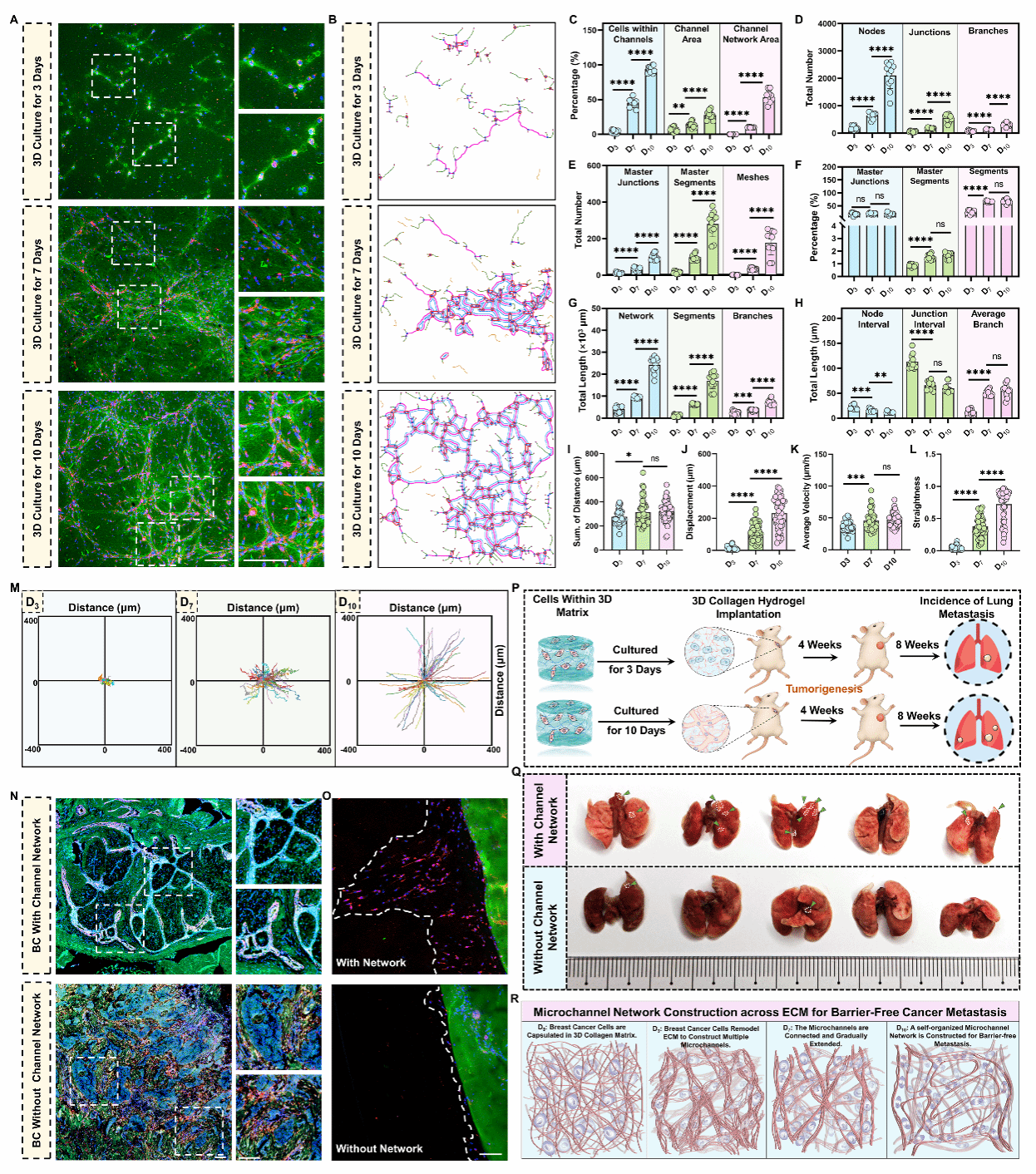
The extracellular matrix (ECM) is the primary physical barrier to tumor metastasis, while distant metastasis remains a central challenge in clinical treatment. Previous studies have focused only on microchannel formation at the single-cell level, and the extension patterns and mechanisms at the multicellular level have not yet been clarified. In this study, the investigators innovatively shifted the focus to cancer cell collectives and, for the first time, found that cancer cells can cooperatively self-assemble ECM microstructures to construct interconnected microchannel networks with topological features. Like “highways”, these networks can markedly enhance the migration efficiency of cell collectives, revealing a new mode of highly efficient tumor metastasis.
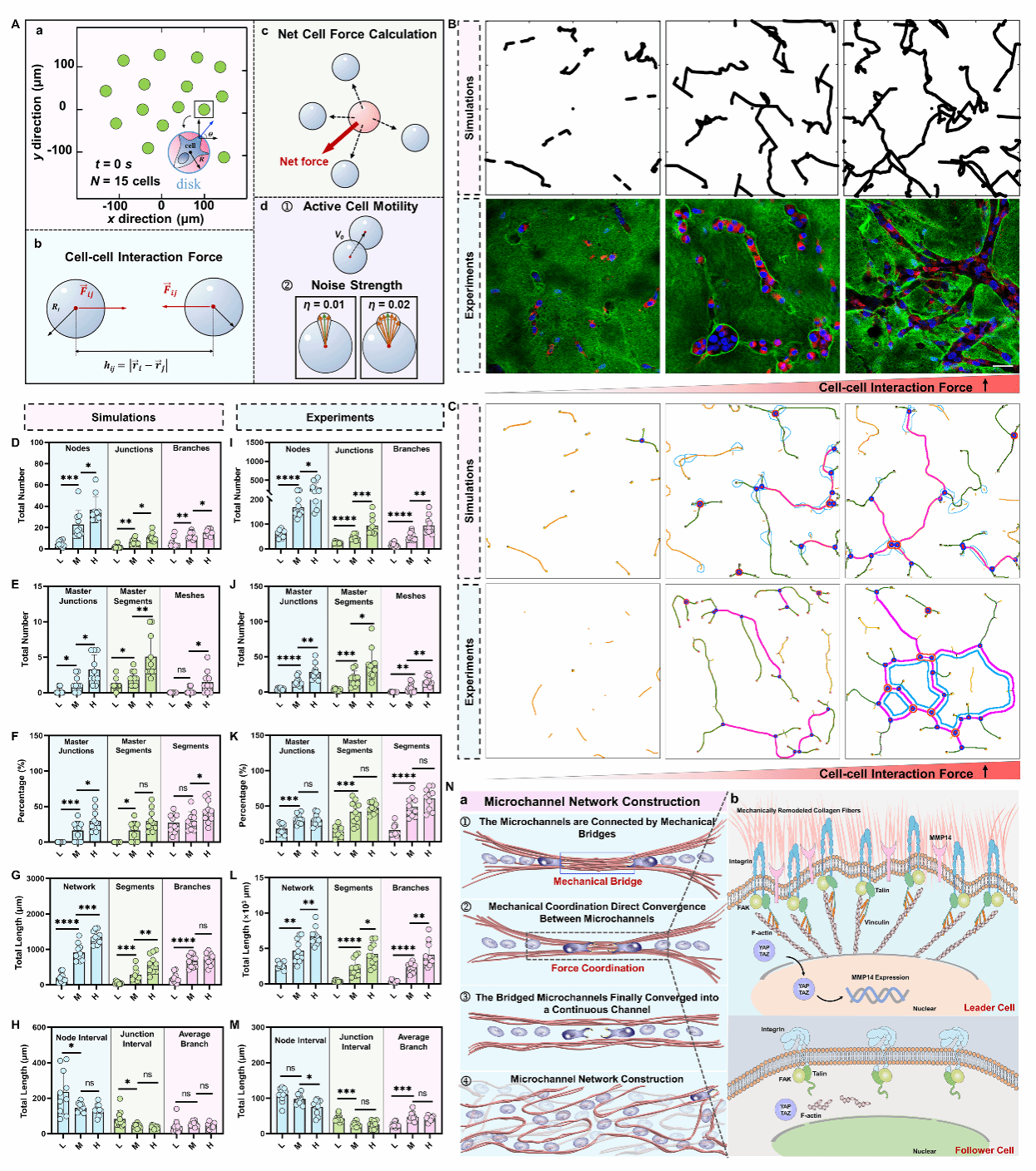
To elucidate the underlying mechanism, the team leveraged a self-developed integrated platform combining atomic force microscopy, optical tweezers and confocal imaging, together with multidisciplinary approaches including single-cell sequencing, molecular interventions and mathematical modeling, to achieve in situ mechanobiological characterization throughout the entire process. The study found that microchannel interconnections are not random; rather, under coordinated force generation by cancer cell collectives, they extend and converge in specific directions guided by “mechanical bridges”. In addition, the team identified force-sensitive leader cells enriched in the Integrin-RhoA/YAP signaling axis and MMP14, which drive the extension and convergence of microchannels, providing key targets for mechanistic investigation.
The study, entitled “Multicellular force coordination constructs microchannel networks for barrier-free metastasis across extracellular matrix”, was recently published online in Science Advances. Gao Huan, a physician-researcher jointly supervised by Professor Yang Jin from the Phase I Clinical Trial Research Center of the FAH of XJTU (the first-author affiliation) and Professor Xu Feng from the BEBC of XJTU, is the first author, with Professor Cheng Bo and Professor Jin Guorui of XJTU serving as co-first authors. Professor Yang Jin and Professor Xu Feng, together with Academician Xu Binghe, Honorary Director of the Cancer Center of the FAH of XJTU, Professor Jin Guorui and Professor Lin Min of BEBC, and Professor Guo Hui of the Second Affiliated Hospital of XJTU, are co-corresponding authors. This study was conducted with support from the BEBC of XJTU and the Precision Medicine Research Center of the FAH of XJTU, and was funded by Key/General/Young Scientist projects of the National Natural Science Foundation of China, as well as by based such as the National Medical Research Breakthrough Industry-Education Integration Innovation Platform.
Article link: https://www.science.org/doi/10.1126/sciadv.adz4291