Immune checkpoint blockade (ICB) therapy has markedly improved outcomes for multiple cancers; however, its efficacy remains limited in prostate cancer and other “immune-cold” tumors, with clinical response rates of less than 5%. In theory, radiotherapy can enhance antitumor immunity by inducing DNA damage and activating the cGAS-STING pathway, yet multiple clinical trials have shown that radiotherapy combined with immunotherapy yields suboptimal results in prostate cancer, leaving the field at an impasse.
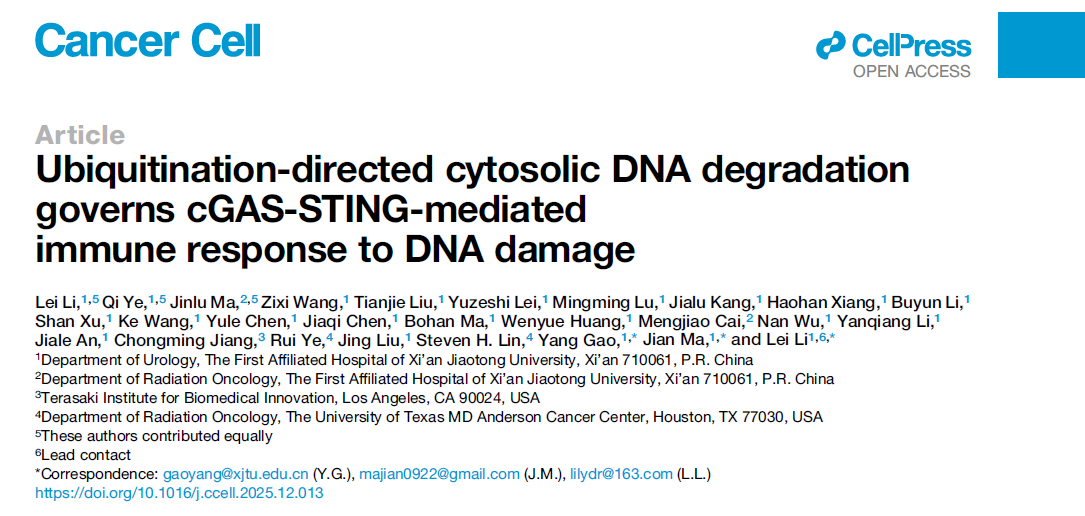
Recently, the team of Li Lei, Ma Jian, and Gao Yang from the First Affiliated Hospital (FAH) of Xi’an Jiaotong University (XJTU) published a research paper titled “Ubiquitination-directed cytosolic DNA degradation governs cGAS-STING-mediated immune response to DNA damage” in the prestigious international oncology journal Cancer Cell. This study focuses on the critical issue of suboptimal clinical outcomes of combined radiotherapy and immunotherapy. It reveals the intrinsic regulatory mechanisms by which tumor cells respond to radiotherapy-induced immune activation, providing important insights and new treatment strategies for understanding why some patients are insensitive to radio-immunotherapy.
Through multi-cohort clinical data analysis, this study found that some prostate cancer and endometrial cancer patients, despite having a high tumor mutational burden, still exhibited low levels of immune cell infiltration. This suggests that relying solely on traditional biomarkers is insufficient to accurately predict the efficacy of immunotherapy. This discovery provides a new reference direction for patient stratification and efficacy evaluation in combined radiotherapy and immunotherapy.
This study proposes that targeting the key regulatory molecule USP7 may restore radiotherapy-induced antitumor immune responses, thereby enhancing the efficacy of immunotherapy. This strategy offers a potential translational path to overcome radio-immunotherapy resistance and optimize combination treatment regimens, with clear clinical application prospects.
This study provides a new theoretical foundation and practical direction for the precision and personalized application of combined radiotherapy and immunotherapy. It is of significant importance for improving treatment outcomes in “immune-cold tumors” patients.
Professor Li Lei, Professor Ma Jian, and Professor Gao Yang from the FAH are the co-corresponding authors of this paper. Dr. Li Lei, Dr. Ye Qi, and Professor Ma Jinlu from the FAH are the co-first authors.
Original article link:https://doi.org/10.1016/j.ccell.2025.12.013